Maximize Your Benefits with Skadi’s Out-of-Network (OON) Services
Finding a sport psychologist or mental health therapist as an athlete can be tough — especially if you're hoping to use insurance. With so many providers out there, it can feel like acronym soup, and the insurance game can make it feel even more complicated. At Skadi Sport Psychology, we provide athletes with top-tier mental health and performance therapy to help them succeed both on and off the field. One thing that sets us apart is that we're an out-of-network practice. That's different from being in-network, and it's also different from being strictly private pay.
If you're not sure what that means or why we've chosen this model, this article breaks it down: what out-of-network care involves, why we believe it allows us to provide the best care, and how it benefits our athletes.
What "Out-of-Network" Means for Your Therapy
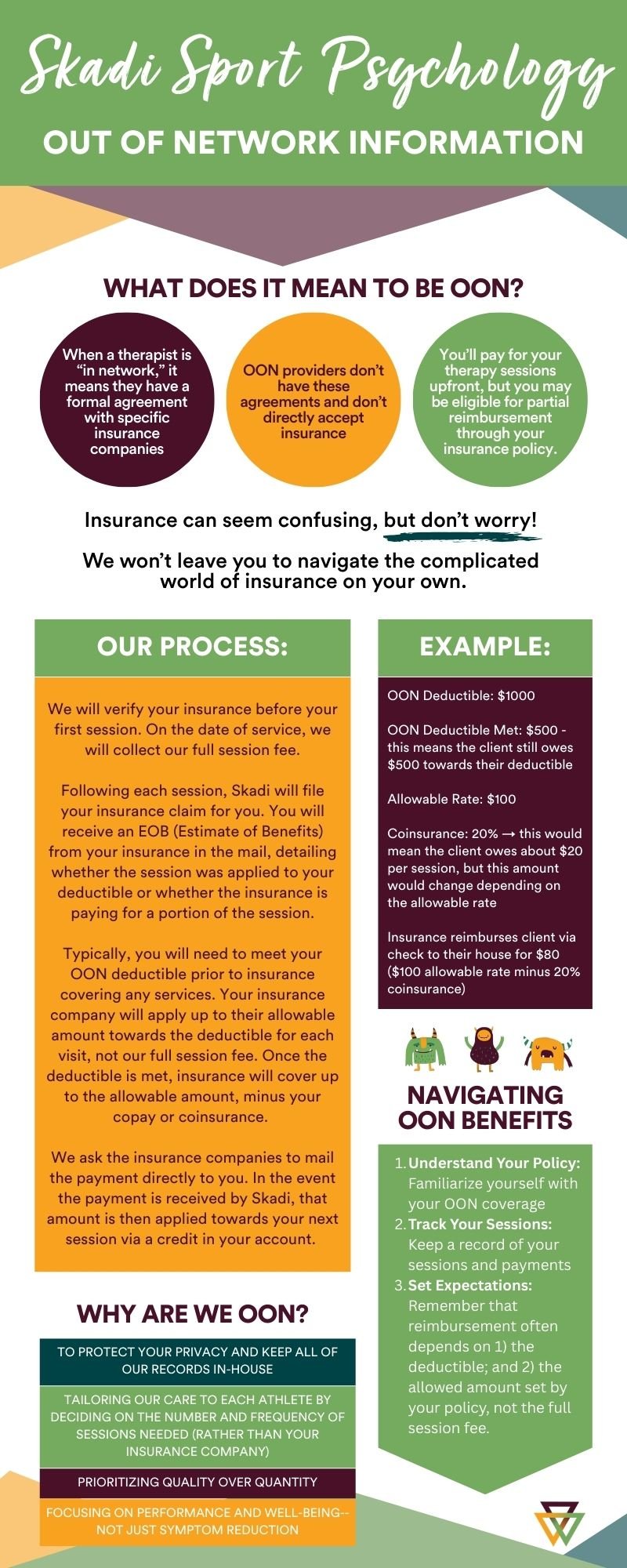
When a therapist is in-network, they have a formal contract with specific insurance companies to provide services at pre-negotiated rates. Out-of-network providers don't have those contracts and don't bill insurance directly for a contracted rate. In practice, this means you pay for your sessions up front, and you may be eligible for partial reimbursement through your plan's out-of-network benefits.
This isn't unusual in mental health care. Patients are far more likely to receive behavioral health care out of network than they are for other medical or surgical services, in part because many therapists — including nearly half of psychiatrists in some studies — don't participate in insurance networks (Huskamp & Iglehart, NEJM, 2016; Benson & Song, Health Affairs, 2020).
How Skadi Handles the Insurance Legwork for You
What sets us apart is that we don't leave you to navigate insurance alone. Many out-of-network providers simply hand you a superbill — an itemized receipt — and leave it to you to call your insurer, decode your benefits, and submit claims yourself. That often creates unnecessary stress and confusion.
At Skadi, we've streamlined the process. During your onboarding process, we check your out-of-network benefits for you. Here's how it works:
1. Insurance Verification
Before your first session, our team will verify your insurance benefits to confirm your OON coverage. We do this by calling your insurance directly and sharing your information with them to verify what's covered (and what's not). This ensures there are no surprises and helps you understand how insurance reimbursement will work.
2. Upfront Payment
On the day of your session, we collect our full session fee via our electronic scheduling system. This keeps the process efficient and all payments coincide with the date of the session so you know exactly what you're paying for.
3. Claim Filing by Skadi
After your session, we handle the insurance claim for you! You won’t have to worry about filing paperwork—we’ll take care of submitting everything to your insurance provider. The session cost will go to your OON deductible. it will be submitted for partial or full reimbursement.
4. Your Insurance Explanation of Benefits
Within a few weeks, you’ll receive an Explanation of Benefits (EOB) from your insurance company (typically in the mail). This document will detail whether your session payment contributed toward your deductible or whether the insurance is reimbursing a portion of the session.
5. Insurance Reimbursements
Most insurance companies mail reimbursement checks directly to you. If they mistakenly send it to us, we apply the amount as a credit to your next session.
This system allows you to focus on your sport psychology sessions with less stress about administrative tasks. Of course, if you have any questions, you're always welcome to email us.
How Reimbursement Actually Works: Deductibles and "Allowed Amounts"
Two things determine what you get back. First, most plans have a separate out-of-network deductible that must be met before the plan pays anything — and the Affordable Care Act's out-of-pocket cap does not apply to out-of-network care (Xu et al., JAMA Network Open, 2019). Second, reimbursement is based on the "allowed amount" your insurer sets for that service, not necessarily your full session fee (Benson & Song, Health Affairs, 2020).
For example, if we charge $205 for a session but your insurer's allowed amount for that service is $110, your reimbursement is calculated from the $110 — not the $205. Coverage varies from plan to plan, and we're here to help you understand your specific options and make informed decisions.
Why Skadi Chose to Be Out-of-Network
Our decision to remain OON wasn't made lightly — it's grounded in our mission to provide the highest-quality care. Here are the key reasons.
1. Protecting Your Privacy — With an Honest Caveat
Many of our clients are high-profile athletes, or athletes with marginalized identities (for example, trans and non-binary athletes, or athletes with disabilities), who understandably want strong confidentiality. Staying out of network gives us more control over what leaves our office. Because we aren't governed by an insurer's contract, insurers do not have contractual access to your progress notes or treatment plan.
One important honest note: if you choose to have us submit out-of-network claims so you can be reimbursed, your insurer will still receive certain required information — most importantly a mental health diagnosis code and the dates and types of service — because that's what any insurer requires to process a claim (Xu et al., JAMA Network Open, 2019). If you want no clinical information shared with your insurer at all, the only way to guarantee that is to pay privately and not submit a claim. We're always happy to talk through which approach fits your privacy needs.
2. Care Tailored to Each Athlete
Insurers often place limits on the type, duration, and frequency of therapy, and they may require an ongoing diagnosis to justify continued care. (Federal parity law bars insurers from applying stricter limits to mental health than to medical care, but utilization review and medical-necessity requirements still shape in-network care (Busch et al., BMC Health Services Research, 2017).) Staying out of network lets us keep full clinical autonomy — adjusting the cadence of sessions around your season (off-season, championship prep) or unexpected challenges — based on your needs rather than a reviewer's checklist.
3. Quality Over Quantity
Insurance reimbursement for mental health has barely moved in two decades — Medicare's rate for a 45-minute psychotherapy session rose only about 2.5% from 2001 to 2024 while inflation rose roughly 75% — which pushes many in-network providers toward large, hard-to-manage caseloads (Lehrbach et al., Administration and Policy in Mental Health, 2026). That's not the environment we want for you or our therapists. We intentionally keep our caseloads small so we can offer personalized, attentive care — remembering the names of your pets, coaches, and key competitions — and build tailored resources for you (podcasts, book recommendations, worksheets, assessments). Smaller caseloads also let us accommodate urgent requests.
4. Focus on Performance and Well-Being, Not Just Symptoms
Our work often goes well beyond addressing distress. For athletes, peak performance, well-being, and mental resilience matter just as much. This focus is well founded: sport psychology interventions such as psychological skills training, imagery, and mindfulness- and acceptance-based approaches have moderate, meaningful effects on athletic performance (Lochbaum et al., PLOS One, 2021; Reinebo et al., Sports Medicine, 2024). Out-of-network care frees us from a narrow, diagnosis-driven focus so we can work holistically with you as both person and athlete.
Understanding the costs of sports psychology services can help you make informed decisions about your care. For a detailed breakdown of what affects pricing and how to find affordable options, check out our blog post on How Much Does a Sports Psychologist Cost?
Benefits for Athletes and Families
· Personalized attention. With smaller caseloads, we get to know you on a deeper level — from your pre-competition nerves to your training environment.
· Flexible, athlete-centered care. Whether you need extra sessions during competition season or a performance-psychology focus, your care evolves with your life — because it's designed around you, not an insurance policy.
· Strong privacy control. We give you clear choices about what is and isn't shared, and we protect sensitive information to the fullest extent your reimbursement choice allows.
· Hassle-free support. No time on hold or decoding superbills — we handle claims submission for you and answer your questions.
Common Questions About Out-of-Network Care
"Isn't out-of-network care more expensive?"
It can be. Out-of-network psychotherapy generally carries higher up-front costs and cost-sharing than in-network care (Benson & Song, Health Affairs, 2020). Our concierge insurance support helps you maximize your out-of-network benefits, and many clients are pleasantly surprised by how much they're reimbursed. We're upfront that our services come at a higher cost — and we believe quality care is an investment in the personalized support you deserve.
"Will the claims process be complicated?"
Not for you. We handle claim submission and paperwork. Your role is simply to provide your insurance information and focus on therapy.
Tips for Maximizing Your Out-of-Network Benefits
· Understand your policy. Learn your out-of-network deductible and reimbursement rate — we'll help with this at intake.
· Track your sessions. Keep a record of sessions and payments in case you need to follow up. We keep this too and can share it anytime.
· Set realistic expectations. Reimbursement depends on (1) your out-of-network deductible and (2) the allowed amount your plan sets — not your full session fee. Many healthy athletes carry high-deductible plans, which affects how quickly reimbursement kicks in.
If you're unsure where to start, we're here to guide you.
Partnering With You for Better Performance
Everything we do is rooted in supporting athletes and their families through challenges and opportunities alike. By choosing to be out of network, we can deliver personalized, confidential, high-quality care that prioritizes your needs — not the fine print of a policy.
If you’re ready to take the next step in performance enhancement or simply have more questions about using OON benefits, we’re happy to help. Schedule your free consult today to ask your questions about the OON process and we'll help you determine whether we'd be a good fit for you.
References
1. Benson NM, Song Z. Prices and Cost Sharing for Psychotherapy in Network Versus Out of Network in the United States. Health Affairs. 2020.
2. Busch SH, Kyanko K. Assessment of Perceptions of Mental Health vs Medical Health Plan Networks Among US Adults With Private Insurance. JAMA Network Open. 2021.
3. Xu WY, Song C, Li Y, Retchin SM. Cost-Sharing Disparities for Out-of-Network Care for Adults With Behavioral Health Conditions. JAMA Network Open. 2019.
4. Busch SH, McGinty EE, Stuart EA, et al. Was Federal Parity Associated With Changes in Out-of-Network Mental Health Care Use and Spending? BMC Health Services Research. 2017.
5. Huskamp HA, Iglehart JK. Mental Health and Substance-Use Reforms — Milestones Reached, Challenges Ahead. NEJM. 2016.
6. Lehrbach KR, Last BS, Rawa E, et al. Using Demand Analysis to Examine Private Practice Mental Health Providers' Decision to Accept Health Insurance. Administration and Policy in Mental Health. 2026.
7. Lochbaum M, Stoner E, Hefner T, et al. Sport Psychology and Performance Meta-Analyses: A Systematic Review of the Literature. PLOS One. 2021.
8. Reinebo G, Alfonsson S, Jansson-Fröjmark M, Rozental A, Lundgren T. Effects of Psychological Interventions to Enhance Athletic Performance: A Systematic Review and Meta-Analysis. Sports Medicine. 2024.